
Eviction Notice Template
An Eviction Notice is a written notification provided by a landlord to a tenant when the terms of a lease have been breached, whether through property damage or unpaid rent. It outlines a specific time frame for the tenant to either correct the problem or move out.
Trusted by 67,527 users.
The rented property is a:
Fill forms in a few steps
Save, print & download
Done in 5 minutes
What Is a Notice of Eviction?
An Eviction Notice, or Notice of Eviction, is a notification that a landlord will begin the eviction process to legally remove a tenant from a rental unit.
As a landlord, there are several reasons you may begin an eviction, such as:
- Choosing not to renew the rental contract
- Violating lease conditions or terms
- Causing significant property damage
- Involvement in illegal or disruptive activities on the property
- The tenant’s failure to pay rent on time
The process usually starts when the landlord issues a notice to vacate within a specific time frame. If the tenant does not respond or resolve the issue, the matter may proceed to court for formal eviction proceedings.
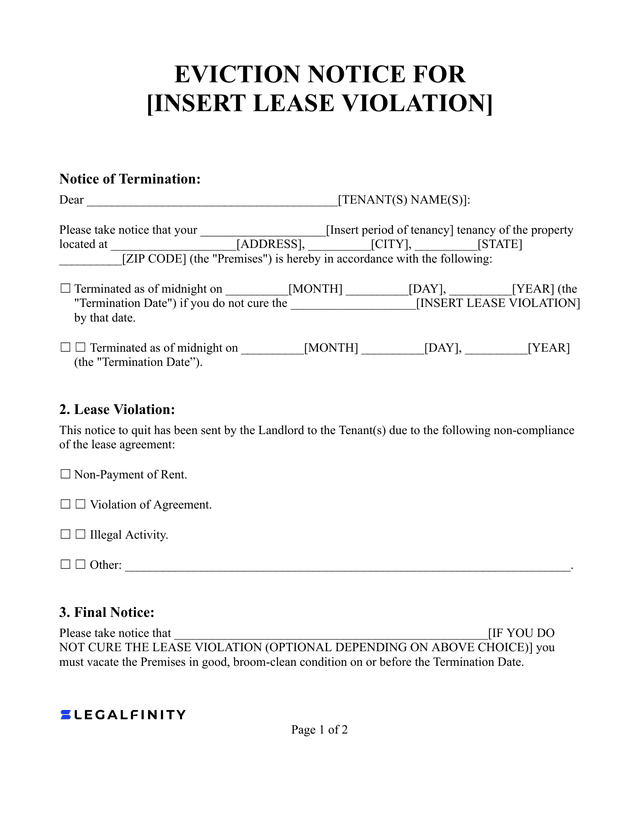
Example of an Eviction Notice
Review our sample Eviction Notice below to see in detail what a completed notification letter should look like.
Eviction Notice Letter by State
Eviction Notice Types
You may issue a specific version of an Eviction Notice, depending on the reason for the eviction and the specific lease violation.
Review the common types of Eviction Letters below.
Notice to Vacate for Non-Renewal
This type of notification is sent when a landlord decides not to extend the lease at the end of its term. It lets the tenant know they must leave the premises by a specific date, usually at the end of the term or the end of the month.
Cure or Quit Notice
You can use this type of Eviction Notice when a tenant breaches a term of the lease, such as keeping an unauthorized pet or causing disturbances. However, the tenant is given time to fix the problem to avoid eviction.
Pay or Quit Notice
A pay or quit notice is issued when rent is overdue. This notice gives the tenant a set number of days to pay any rent that has not yet been paid, or they will need to move out of the property.
Unconditional Quit Notice
This is considered to be the most serious type of notification, which requires the tenant to leave immediately without a chance to resolve the issue. It is typically only used for major violations or illegal actions.
How To Write an Eviction Notice Letter
Creating an Eviction Notice is relatively straightforward and can be done on your own. However, it’s important not to forget to include any key terms or explanations, as any omissions could allow a tenant to challenge the eviction in court.
To prepare a complete and valid Eviction Notice, follow these key steps:
- List the parties and property: Include the full name of each party (landlord and tenant) and the full address of the rental unit.
- State the reason for eviction: Clearly specify the cause for issuing the Notice of Eviction.
- Set clear deadlines: Indicate the legally required notice period in your state and the date by which the tenant must either comply or vacate.
- Explain potential legal actions: Explain that failing to meet the terms of the notice may lead to formal eviction proceedings.
- Sign and date the document: Make sure the notice is properly signed and dated before delivery.
If the property is subject to rent control or is part of a government-assisted housing program (such as Section 8), make sure to follow any additional eviction requirements.
Try our Eviction Notice template to help simplify the process. Once completed, it can be quickly reviewed by a real estate attorney to confirm it meets legal standards.
State Eviction Notice Laws
State rental property laws dictate the specific requirements for an Eviction Notice, meaning it’s critical to adhere to requirements regarding notice periods, delivery methods, and more.
Follow the table below to see specific requirements for your state:
| State | Days to Pay or Vacate | Days to Cure or Vacate | Laws |
|---|---|---|---|
|
AL |
7 days |
14 days | |
|
AK |
8 days |
10 days | |
|
AZ |
5 days |
11 days | |
|
AR |
14 days | ||
|
CA |
3 days |
3 days | |
|
CO |
10 days |
10 days | |
|
CT |
3 days |
15 days | |
|
DE |
5 days |
7 days | |
|
FL |
3 days |
7 days | |
|
GA |
7 days (after receiving a Dispossessory procedure summons) |
No specified period | |
|
HI |
15 days |
10 days | |
|
ID |
3 days |
10 days | |
|
IL |
5 days |
10 days | |
|
IN |
10 days |
10 days | |
|
IA |
3 days |
7 days | |
|
KS |
10 days |
14 days | |
|
KY |
7 days |
14 days | |
|
LA |
5 days |
5 days | |
|
ME |
7 days |
7 days | |
|
MD |
10 days |
14 days | |
|
MA |
14 days |
90 days | |
|
MI |
7 days |
No specified period | |
|
MN |
14 days |
No specified period | § 504b.321 |
|
MS |
3 days |
14 days | |
|
MO |
Immediate |
10 days | |
|
MT |
3 days |
21 days | |
|
NE |
7 days |
20 days | |
|
NV |
7 days |
15 days | |
|
NH |
7 days |
10 days | |
|
NJ |
Not necessary or 30 days if landlord has accepted late rent previously |
30 days | |
|
NM |
3 days |
30 days | |
|
NY |
14 days |
30 days None if illegal activity has been committed on the property | |
|
NC |
10 days |
None or 10 days if substantial damage has been done to the property | |
|
ND |
3 days |
30 days | |
|
OH |
3 days |
3 days | |
|
OK |
5 days |
15 days | |
|
OR |
3 or 6 days |
14 days | |
|
PennsylvaniaA |
10 days |
15 days (for leases of less than 1 year) 30 days (for leases of over 1 year) | |
|
RI |
5 days |
15 days | |
|
SC |
5 days |
14 days | |
|
SD |
3 days |
30 days | |
|
TN |
14 days |
30 days | |
|
TX |
3 days |
3 days | |
|
UT |
3 days |
7 days | |
|
VT |
14 days |
30 days | |
|
VA |
5 days |
21 or 30 days | |
|
WA |
14 days |
10 days | |
|
WV |
Immediate |
30 days | |
|
WI |
14 days |
30 days | |
|
WY |
3 days |
3 days |
How To Serve an Eviction Notice
The way you deliver your carefully prepared eviction notice is just as important as the information it contains.
State law usually sets out specific rules on how you must deliver your signed and dated eviction notice before the notice period officially begins.
This is done to prevent disputes by ensuring that the tenants clearly and demonstrably know that they have been given legal notice to leave or correct a lease violation.
Depending on the state the landlord may serve the notice themselves or hire a certified process server to do the job for them.
However, it is essential to check the correct way to deliver your eviction notice in your state before sending it to the tenant.
Some commonly accepted delivery methods are:
- Hand delivery
- Registered/certified mail
- Posting notice on the property
- Posting the notice on the property and mailing a copy by registered/certified mail
- Delivery as specified in the tenant’s lease
How To Evict a Tenant
In many cases, rental issues can be resolved through communication without taking legal action. However, when a solution cannot be found, starting a formal eviction process may be necessary.
To legally remove a tenant from your property, follow these general steps:
- Serve the Notice: Provide the tenant with a written notice outlining the lease violation and the time allowed to fix the issue or vacate the property.
- File a court complaint: If the tenant doesn’t leave within the specified period, submit an eviction complaint to your local court.
- Attend the court hearing: Both parties will have the opportunity to present their case before a judge.
- Wait for the court’s decision: The judge will determine whether the eviction meets legal requirements and if the tenant has any right to remain in the property.
- Obtain a warrant of eviction: If you prevail, the court will issue a warrant (writ of possession or writ of recovery), which allows law enforcement to remove the tenant.
- Recover possession: The tenant must vacate the property. Depending on local regulations, they may also be responsible for unpaid rent or the landlord’s legal costs.
Price of Evicting a Tenant
The cost of an eviction will depend in large part on your state laws, the tenant’s response, and how far the case proceeds.
- Initial fees: If the issue is resolved after sending an eviction notice and no court action is needed, expenses are usually lower.
- Legal proceedings: When a tenant refuses to leave, they can increase costs. Court filings and related expenses can total anywhere from $500 to $10,000, depending on the case.
- State differences: Each state sets its own court fees and eviction rules. Be aware of the general cost in your area.
Before starting the process, it’s best to check local eviction costs and filing requirements.
How Long Does the Eviction Process Last?
The timeline for evicting a tenant can range from a few days to several months, depending on the situation.
If the tenant cooperates and the notice is prepared correctly, the process may be resolved quickly. However, if the tenant contests the eviction, refuses to leave, or if the notice contains errors, the case can drag on significantly longer.
The exact duration depends on state and county laws, as well as the tenant’s actions. Always remember to follow your state’s notice period and legal procedures to avoid delays and help make sure the eviction is enforceable.
Preview of your Eviction Notice
_________
_________
_________, California _________
_________, _________, California _________
| _________ | to | _________ | $_________ | ||
| Total: | $0.00 |
Address: _________, _________, _________ _________
Payment must be made by 10:00 AM on _________
(Payment can be made in person between the hours of 9am and 5pm Monday through Sunday).
Phone Number: _________
Dated: _________
By: ______________________________
_________
_________, _________, _________ _________
_________
I, the undersigned, _________, being at least 18 years of age, certify and declare under penalty of perjury that on the _____ day of _____________, 20___ I served the above notice to the tenant(s) personally to the person in possession of the property, or in the manner(s) indicated below:
__ On _____________, after attempting personal service, by delivering it on the premises to a member of suitable age of his/her family or household or an employee of suitable age and discretion at the residence/business of the tenant(s), with a request that it be delivered to the person in possession of said premises, AND deposited a true copy in the U.S. Mail, in a sealed envelope with postage fully prepaid, addressed to the tenant(s) at his/her place of residence.
__ On _____________, after attempting service in both manners indicated previously, I served this notice by posting it in a visible place at the residence of the tenant(s), AND I deposited a true copy through Certified U.S. Mail, in a sealed envelope with postage fully prepaid, addressed to the tenant(s) or the person(s) in possession of the property at his/her/their place of residence.
Executed on ____________________
Served by ______________________
Try Legalfinity Now
Instant and complete access to our entire library of legal forms
Edit, download and print in PDF and Word format from any device
Save time and money on legal document creation