
Power of Attorney Template
A Power of Attorney is a legal document used to allow another person to make important decisions about your finances or health on your behalf. You can specify the exact powers you want this person to have and decide when you want it to come into effect.
Trusted by 69,501 users.
Create Your State-Specific POA
Fill forms in a few steps
Save, print & download
Done in 5 minutes
Key Takeaways About Power of Attorney
- A Power of Attorney lets you give someone legal authority to act for you in financial, medical, or personal matters.
- You can choose when it takes effect: immediately, on a set date, or only after you become incapacitated.
- Different POA types cover specific needs, like healthcare decisions, child care, or managing money.
- Each state has unique signing and notarization rules, so always follow local requirements.
- A POA automatically ends when revoked, expired, or after the principal’s death.
How a Power of Attorney Works
A Power of Attorney is a written authorization that lets you (the principal) name a trusted person (your agent or attorney-in-fact) to act for you.
With the right POA, someone you choose can manage money, property, or health decisions when you’re unavailable or unable to decide for yourself. You typically make one when you’ll be away from home for a long period or if for some reason you will be incapacitated.
You can decide exactly what powers you want your agent to have. Likewise, you can also decide when it comes into effect or revoke it at any time.
When a POA Makes Sense
You can use a POA to guarantee that your affairs are taken care of if you’re incapacitated or unable to deal with them yourself. Here are common scenarios and what an agent can do.
| Situation | What your agent can handle | Typical examples |
|---|---|---|
| Business or personal travel (in the U.S. or abroad) | Day-to-day money and property tasks | Pay rent/utilities, manage bank transfers, sign routine paperwork |
| Medical emergency or planned surgery | Healthcare decisions when you cannot speak | Choose treatment options, access records, coordinate with providers |
| Long-term planning | Ongoing financial management | Oversee investments, file taxes, manage benefits and pensions |
| Real estate or investments | Transactions while you’re away | Buy/sell property, sign closing docs, deal with brokers |
| Family support | Limited, specific acts | Make permitted gifts, reimburse caregivers, handle insurance claims |
Sample Power of Attorney Template
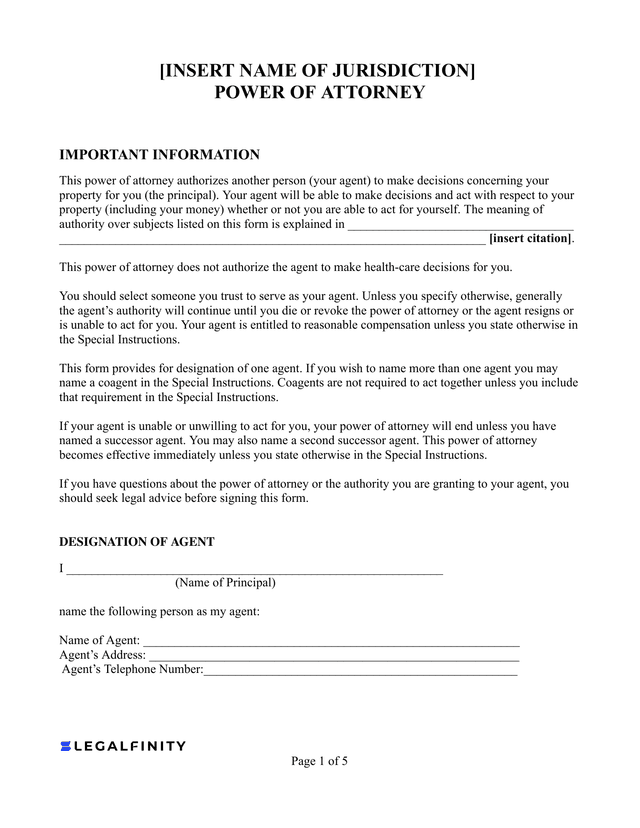
You should understand what a POA generally contains before you draft your own version of this document. You can use this sample as a guide:
Different Power of Attorney Types
Durable (Financial) Power of Attorney
A Durable Power of Attorney (DPOA) lets you name someone to manage your finances and property if you become unable to do it yourself.
Medical Power of Attorney
A Medical Power of Attorney gives a trusted individual the authority to make healthcare and treatment decisions on your behalf if you can’t communicate your wishes.
Power of Attorney for Child
A Power of Attorney for a Child allows parents to temporarily transfer decision-making authority for their child’s care and daily needs to another responsible adult.
Limited (Special) Power of Attorney
A Limited Power of Attorney grants an agent permission to handle a specific task within a set timeframe, like signing a document or selling a property.
Springing Power of Attorney
A Springing Power of Attorney only takes effect after a specific event or condition occurs, such as the principal becoming incapacitated.
General Power of Attorney
A General Power of Attorney authorizes your agent to manage nearly all your legal and financial matters while you are still capable of overseeing their actions.
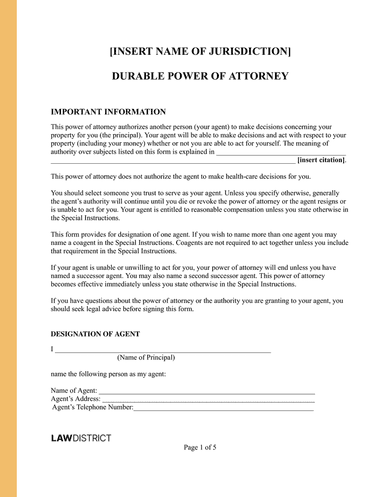
A Durable Power of Attorney form (DPOA) is a legal instrument that enables an individual to designate a trusted person to manage their financial affairs should they become incapable of doing so themselves
A Durable Power of Attorney form (DPOA) is a legal instrument that enables an individual to designate a trusted person to manage their financial affairs should they become incapable of doing so themselves
State-Specific POA Templates
Each state has different laws surrounding the use of this legal form. Find one for your state below:
How To Create a POA
Follow these simple steps to make a POA tailored to your situation:
- Pick the right agent (and a backup). Choose someone trustworthy, organized, and available. You can name co-agents or successors.
- Define powers clearly. Decide what your agent can and cannot do. You can grant broad authority or list specific permissions.
- Choose durability and timing. Will it be effective immediately, on a set date, or only after a trigger (springing)? Should it remain effective if you become incapacitated (durable)?
- Add any limitations and instructions. Set caps for gifts, require two signatures for major transactions, or restrict certain assets.
- Sign the right way for your state. Most financial POAs require notarization, and some also need witnesses. Healthcare POAs often have their own witness rules.
- Share and store wisely. Keep the original somewhere safe but accessible. Give copies to your agent and relevant institutions (banks, doctor’s office). Keep a digital copy for quick reference.
You can quickly make a professional, comprehensive POA in just a few minutes with our Power of Attorney template and intuitive document creation tools.
How the Uniform Power of Attorney Act (UPOAA) Affects POAs
Many states have adopted the UPOAA to bring consistency to financial POAs. In these states, the law clarifies: who can serve as an agent, which powers can be granted (including any that must be expressly stated), and how third parties should accept a POA.
If your POA follows your state’s statute, it’s far more likely to be honored without delay.
Possible Financial Powers with a POA
If you’re thinking about making a Financial Power of Attorney, it’s important to understand what your Attorney can and cannot do. Here is a quick table of what is usually permitted:
| Authority Area | Typical Agent Actions | Notes |
|---|---|---|
| Banking & payments | Open/close accounts, pay bills, transfer funds. | Some banks prefer their own forms. You should bring your POA anyway. |
| Investments | Buy/sell securities, work with brokers. | Consider written guardrails for risk level. |
| Real estate | Sign listings, purchase/sale contracts, closings. | Title companies often require notarized, recent copies. |
| Benefits & pensions | Manage Social Security, VA, or private benefits. | Agencies may have separate authorization forms. |
| Taxes | Prepare, sign, and file returns; deal with the IRS/state. | An IRS Form 2848 may still be required in some cases. |
| Gifts & family support | Make permitted gifts or support payments. | If allowed, set dollar limits and recipients. |
What To Do Once You Have a Power of Attorney
Even once you have your Power of Attorney in place, it’s important to make sure to update it after important life events, like:
- Marriage
- Divorce
- Having kids
- Moving to a new state
- Acquiring new assets
You should talk to your Agent and make sure they fully understand what your wishes are and the threshold of their power.
Make sure to inform your bank about any changes to your Power of Attorney, and ask if they need anything, so your Agent isn’t delayed later.
Try Legalfinity Now
Instant and complete access to our entire library of legal forms
Edit, download and print in PDF and Word format from any device
Save time and money on legal document creation