
Recommendation Letter Templates
When applying for a job, entering an educational institution, or being admitted to a rental property, a Recommendation Letter is usually required. This letter, written and signed by someone familiar with the individual, helps offer a clear picture of the applicant’s qualifications.
Trusted by 18,920 users.
What kind of recommendation are you making?
Fill forms in a few steps
Save, print & download
Done in 5 minutes
What Is a Recommendation Letter?
Recommendation Letters, also known as Reference Letters, are signed, written endorsements that assess an individual’s character and performance in academic or professional settings.
They also can attest to the applicant’s personal character, especially when applying to rent a property.
Employers and institutions may request a recommendation before an employment agreement is finalized or in other contexts requiring a character reference.
In general, this type of letter:
- Evaluates character and academic/professional performance
- Used for Job applications; college/university admissions
- Is written by teachers, professors, supervisors/managers
- Provides specific examples that illustrate skills, impact, and reliability
Reference Letter Example
Reviewing a printable template or a simple Recommendation Letter example can help you clarify tone, formatting, and the level of detail that’s typically expected.
Review the following Reference Letter sample to help you understand these details:
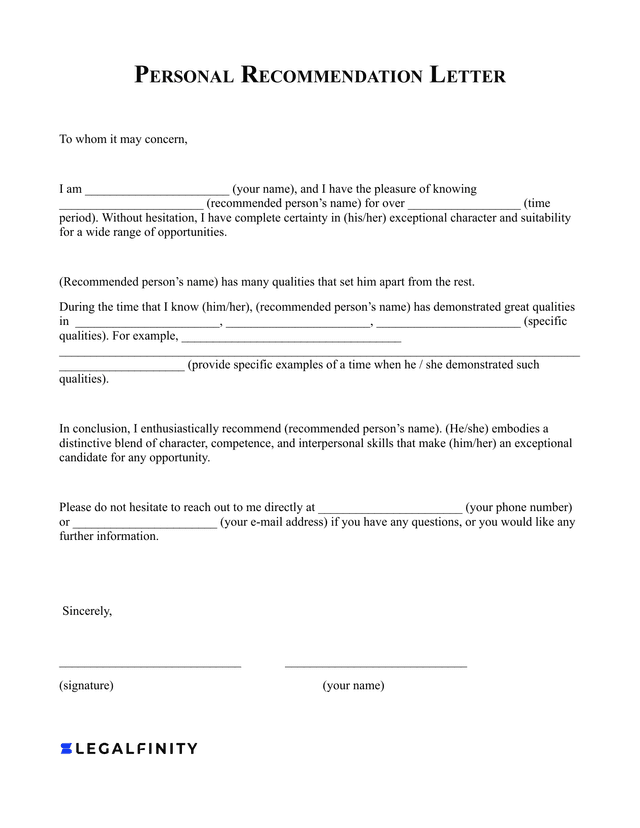
Reference Letter Sample Text
Use the following example as a model for crafting a strong, personalized recommendation. It demonstrates clear structure, concise context, specific evidence, and a professional tone without unnecessary detail.
Rewritten sample letter
[Date]
Greetings,
I am pleased to recommend [Full Name] for [What they are applying for]. I have known [First Name] for [length of time] in my capacity as [relationship/role], and I am confident they will excel in this opportunity due to their [key strengths or qualities].
Over the [Period of time], [First Name] consistently demonstrated [2-3 strengths or accomplishments], which clearly reflects their readiness for [What they are applying for]. Based on this direct experience, I recommend [First Name] without reservation.
If additional information would be helpful, I’m happy to provide it. I can be reached at [phone number] or [email address].
I confirm that the statements herein are accurate to the best of my knowledge, and understand this letter may be reviewed by third parties. This communication, and any follow-up, is subject to applicable privacy laws and regulations.
Sincerely,
[Signature]
[Your Full Name]
[Title/Position]
Keep in mind that as a writer, you can face legal consequences for false or misleading statements, whether intentional or negligent, if third parties reasonably rely on them and are harmed.
Also, only write recommendations grounded in first-hand knowledge. If you cannot provide a truthful, fact-based assessment, it’s best to decline.
Letter of Recommendation Types
Below are rewritten and reorganized descriptions of common recommendation and related letters, with clearer guidance on authors, content, and purpose.
Reference Letter for Law School
A Reference or Recommendation Letter for Law School supports a candidate’s application to JD or equivalent law programs by referencing coursework, moot court, research papers, or internship experiences.
The letter should emphasize competencies relevant to legal training, such as critical reading and writing, argumentation, ethical judgment, perseverance, and evidence-based reasoning.
Recommendation Letter for College
A teacher or counselor will typically write a Reference Letter for College to support a high school student’s application for undergraduate admission. It highlights the student’s academic performance and character.
These letters typically go over courses, extracurricular activities, and provide a clear endorsement of the student’s readiness for college-level work.
Reference Letter for Graduate School
A Reference Letter for Graduate School endorses a student who is currently studying an undergraduate degree or recent graduate for admission to a master’s or doctoral program.
Usually a professor, or another esteemed academic who can mention specific examples, such as independent research, capstone projects, publications, or applied work that demonstrate suitability for graduate study will write the letter.
Thank You Letter
To express appreciation for someone’s support or time, you would write a Thank You Letter.
It is often sent after receiving a recommendation or having completed an interview.
It should be timely, specific about what you’re grateful for, and professional in tone, to help reinforce relationships and leave a positive impression by acknowledging the recipient’s effort.
Immigration Character Recommendation Letter
An Immigration Character Recommendation Letter is a personal declaration that can be used as supporting documentation for someone who is applying to become a resident or citizen of the United States. It must be truthful and comply with all applicable laws and regulations, including 18 U.S.C. § 1001.
The letter is typically written by someone with personal ties to the applicant and should speak from first-hand knowledge about their positive qualities, and be prepared to verify statements under penalty of perjury with specific, concrete examples.
Format of Recommendation Letters
A strong Letter of Recommendation should include the following elements that emphasize credibility and professionalism:
- Introduction and endorsement: Begin with a clear statement introducing yourself and your relationship to the candidate, followed by your endorsement.
- Reasons for recommendation: Outline specific reasons why you support the applicant, by mentioning their qualifications that are relevant with the role or program.
- Personal experience and evidence: Share examples from your direct experience that show off the candidate’s strengths related to the role.
- Conclusion: End the letter with a confident summary of why the applicant would make an excellent addition to the organization or institution.
- Signature and contact information: End with your full name, title, and contact details, while also expressing that you are open to provide further information if needed.
How To Request a Letter of Recommendation
When asking for a Reference Letter, make sure to reach out to the person directly, this should be done:
- In person
- By calling
Clear and polite communication helps set a positive tone for your request.
It’s best to ask at least six weeks before the submission deadline to give the writer enough time to craft a thoughtful and detailed letter.
How To Write a Recommendation Letter
A great recommendation is intentional and tailored to what the applicant is applying for. When planning your letter, start by clarifying the purpose of the letter and the selection criteria.
Think about the candidate’s top attributes and the concrete experiences you’ve observed that demonstrate those qualities. Then structure your letter with the following parts:
1. Introduction
Here is how you should write your introduction and what information you should include about the applicant:
- Identify yourself, your role, and how you know the candidate and for how long.
- Name what the applicant is applying to, then state your clear endorsement up front.
- Optional: Add a brief note that your assessment reflects your professional opinion based on direct observation.
Example:
I am pleased to recommend Jane Doe for the Marketing Manager position at ABC Corp. I have worked with Jane for five years at XYZ Inc., where I supervise her in my role as Director of Marketing. In that time, I’ve observed her consistently deliver high-impact work and lead teams with integrity and skill.
2. Body Paragraph(s)
To write an appealing body section of your Reference Letter, do the following:
- Provide 2-3 specific, verifiable examples that show the candidate’s strengths and results.
- Connect each example to skills the opportunity values, such as leadership or any other relevant skills.
- Quantify outcomes where possible; describe context and impact.
Example:
Last year, Jane led a cross-functional team to launch a digital campaign that increased qualified leads by 28% quarter-over-quarter. She combined sharp audience insights with data-driven testing, and she coached junior staff to execute on a tight timeline. In a separate project, she regenerated our content strategy, improving organic traffic by 35% and reducing acquisition costs by 18%.
3. Conclusion
To properly end your Recommendation Letter, make sure to:
- Solidify your endorsement and the candidate’s fit.
- Provide your contact information and invite follow-up.
Example:
I strongly endorse Jane Doe for this role and am confident she will excel at ABC Corp. If you need additional information, please contact me at (123) 456-7890 or name@example.com.
Try Legalfinity Now
Instant and complete access to our entire library of legal forms
Edit, download and print in PDF and Word format from any device
Save time and money on legal document creation