
Loan Agreement Template
A Loan Agreement is a legal document that lays out the terms of a loan between two parties. It usually includes details like the loan sum, repayment schedule, interest rate, and any collateral provided by the borrower.
Trusted by 4,859 users.
Protect your loan in minutes. What is the money for?
Fill forms in a few steps
Save, print & download
Done in 5 minutes
Key Takeaways About the Loan Agreement
- A Loan Agreement clearly sets the terms between a lender and a borrower.
- It covers the loan amount, repayment schedule, interest, and any collateral.
- Using one can protect both parties if a dispute arises.
- Repayment can be installments, lump sum, or balloon payment.
Understanding a Loan Agreement
A Loan Agreement is a legal document that establishes the legal relationship between a lender and a borrower. It sets out the terms of a loan between these two parties.
The document typically includes:
- How much money is being lent
- When and how it must be repaid
- What interest (if any) applies
You can decide to have the repayments be made weekly, monthly or over the course of years. The loaner could also add interest to the principal amount to compensate for the risk, or the delay in repayment.
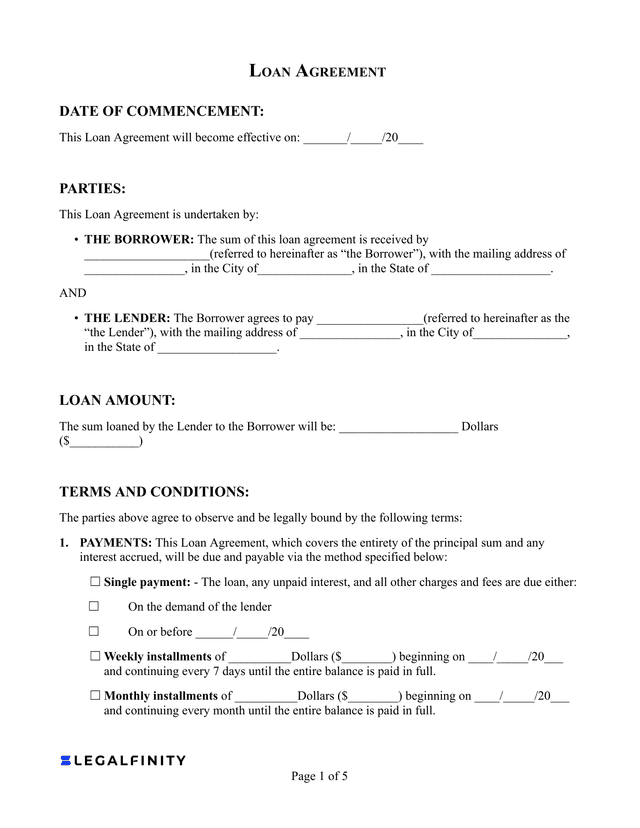
Example of a Completed Loan Agreement
Before creating your own contract, it can help to review a sample Loan Agreement. This can give you an idea of its structure and standard clauses.
Common Types of Loan Agreements
Below is a comparison between two of the most common types of Loan Agreements, an IOU and Personal Loan Agreement:
| Type | Description |
|---|---|
| IOU | A simple, informal acknowledgment of debt between two parties. Though often called a “friendly loan,” it can still hold up in court. |
| Personal Loan Agreement | A more formal contract often used between individuals or with financial institutions such as banks, credit unions, or online lenders. It sets out repayment rules and interest clearly. |
Who Should Use a Loan Agreement?
Anytime you lend money to someone, you should use a loan agreement.
It offers proof of the terms in case the borrower fails to repay. This can be used as legal protection for the lender in the future if a dispute arises.
A Loan Agreement also guarantees transparency. The borrower can see the clear terms and conditions of the loan, and decide if they agree before signing.
How To Make a Loan Agreement
It’s important to clearly lay out the terms when writing this agreement.
You cannot leave any ambiguity about who owes what and when. You should use clear, simple language throughout.
Below are the key elements to include:
| Section | Information to include |
|---|---|
| Effective date | The date when the agreement takes effect |
| Parties involved | Full legal names and addresses of both lender and borrower (plus ID details if needed) |
| Principal sum | The total amount of money being loaned |
| Repayment terms | Method and frequency of payment (installments or lump sum), acceptable payment methods, and any amortization schedule |
| Interest and fees | Interest rate, late fees, grace period, prepayment penalties, and other charges |
| Collateral | Any assets pledged as security for the loan |
| Governing law | The jurisdiction whose laws apply to the contract |
| Signatures | Both parties must sign and date the agreement |
You can use our Loan Agreement template to quickly make and download this document. You can include your own terms, so it fits your situation.
How Repayment Works
Once the borrower receives the funds, payments must follow the schedule as stated in the contract. Most people entering this agreement choose one of the following repayment methods:
| Repayment Method | Description |
|---|---|
| Installments | Regular monthly or weekly payments covering both principal and interest. |
| Lump-Sum Payment | A single repayment of the full amount, typically used for smaller loans. |
| Balloon Payment | The borrower pays smaller installments during the loan term and a large final payment at the end. |
Each option can be customized to fit the size of the loan and the borrower’s financial capacity.
Signing and Finalizing the Agreement
Before signing, confirm any legal requirements in your state.
In most cases, witnesses are optional, but having the agreement notarized or signed before a witness can strengthen its legal validity.
Both parties should keep a signed copy for their records.
You can easily generate a Loan Agreement tailored to your needs. Our smart template guides you through each section step by step, helping you include all required details before signing.
Loan Agreement Vs. Promissory Note
Both a Loan Agreement and Promissory Note record a debt, but they’re used for loans of different complexities.
A Loan Agreement is a full contract that spells out rights, duties, and remedies:
- Detailed terms for both sides
- Add-ons allowed: collateral, fees, covenants
- Stronger remedies if default occurs
- Fits business or higher-value loans
In contrast, a Promissory Note is mainly a written promise to repay. It’s more commonly used in simpler deals:
- Straightforward promise to repay
- Few moving parts, easy to draft
- Basic legal protection
- Good for small, short-term loans between friends or family members
Try Legalfinity Now
Instant and complete access to our entire library of legal forms
Edit, download and print in PDF and Word format from any device
Save time and money on legal document creation