
Free Medical Power of Attorney Form
A Medical Power of Attorney lets the “principal” select an individual known as an “agent” to make healthcare choices on their behalf in line with their wishes. This can be used even in the event of the principal’s incapacitation.
Trusted by 17,189 users.
What type of document you want to create?
Fill forms in a few steps
Save, print & download
Done in 5 minutes
What Is a Medical Power of Attorney (MPOA)?
A Medical Power of Attorney (POA) is a form of Durable POA that allows you to appoint an individual (often known as your agent or attorney-in-fact) to make important health care decisions for you if you cannot [1].
This differs greatly from a General Power of Attorney, which is more commonly used by the public and can only appoint an Agent to manage your financial decision-making. Instead, this type of medical-legal document can be put in place to provide for your healthcare necessities in the event of incapacitation.
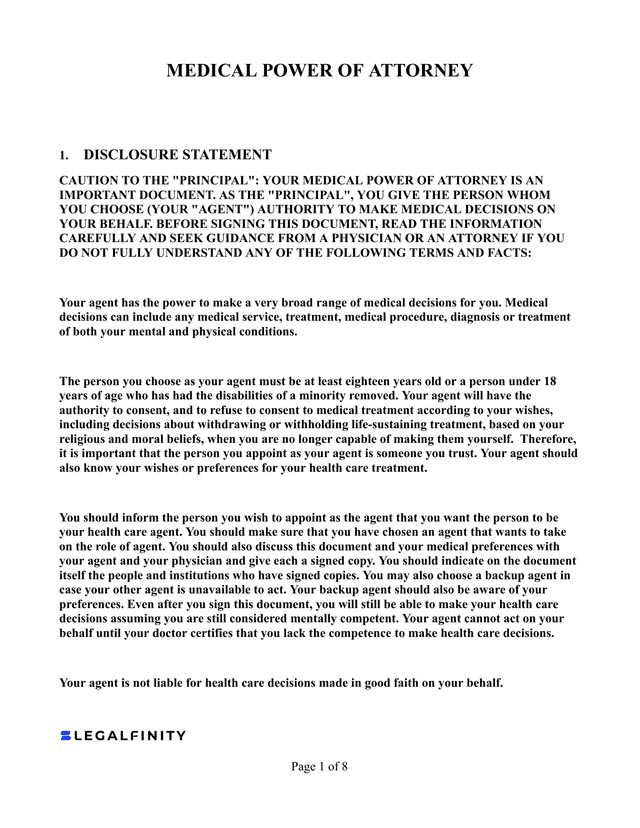
Medical Power of Attorney Sample
Below, you’ll find an example of what a completed Medical Power of Attorney form looks like. This is a standard sample document that cannot be used in all states nor in all contexts. To create your own customized document, use Legalfinity’s POA template builder.
Medical POA vs. Living Will
A Medical Power of Attorney may seem similar to a Living Will to some. However, there are some significant differences between the two legal documents. In fact, both can be used to complement each other as an Advanced Directive documents.
Living Wills, on the one hand, explicitly details your medical treatment preferences. This type of advance directive might be used to approve emergency procedures that will ensure your recovery or to withhold further treatment if your situation is grave and unlikely to improve.
Medical Power of Attorneys, on the other hand, focuses more on the naming of a representative for a patient. It allows you, the Principal, to name a person you trust to give medical consent to treatment when you cannot yourself.
How To Get a Medical Power of Attorney
The process of getting a Medical Power of Attorney is quite similar to other POAs. You can either complete a Healthcare POA form yourself, or you can seek out an Attorney at Law to help you draft the document.
It is possible to find free blank Medical Power of Attorney forms both online and from your healthcare provider. These will give you all you need to name and authorize an Agent to act on your behalf for your medical needs.
Below are the key steps you need to follow to create your own MPOA form.
1. Choose an Agent
As a Medical POA can grant significantly far-reaching powers, your attorney-in-fact needs to be carefully chosen. It doesn’t necessarily have to be a spouse, adult child, or member of your family, but it should always be a competent adult you trust.
You should also speak at length with your prospective agent to be sure that they consent to the type of power and responsibility you’re giving them. Additionally, you must give a very clear picture of what your wishes are regarding your future medical treatment.
There’s also the option to choose a successor or 2nd Agent in case the primary Agent is not able to complete their duties. If desired, you can even set up a compensation plan for the Agent.
2. Define Agent’s Authority
The next stage of creating your document is to clearly define the powers that you will give to your chosen agent [2].
Consider carefully your personal health care situation, and what kind of decisions you will need the agent to take, either in the short or long term. It’s also important to consider when you want to empower the Agent to act.
You can also set a triggering event, such as when a doctor deems you unable to give consent for yourself or start a date for their authority.
You should define the following agent powers in your POA:
- End-of-life decisions
- Hospitalization
- Medical treatment
- Psychiatric Mental Health treatment
- Nursing home care
- Homestay care
- Organ donations
3. Add a Living Will
Although not mandatory, adding a living will (or Directive to Physicians) to your MPOA is highly recommended by many legal and healthcare experts. This will help you outline your end-of-life treatment selections, in addition to having someone to speak on your behalf.
By using a living will, you will be able to define what you want to happen in case you were to end up in an incapacitated state without a chance for a cure. It also allows you to choose post-death options such as organ donation.
4. Sign According to State Requirements
Once your form is completed, it will then need to be signed by both the principal and the agent according to the respective state signing laws. In most states, the form will have to be signed in the presence of two witnesses and/or a notary public.
After it has been finalized, you should then file the form with your healthcare providers so that they have the document on record. This will speed up its use in the future.
Keep in mind that certain states do not allow you to use a universal form. These states are:
- Indiana
- New Hampshire
- Ohio
- Texas
- Wisconsin
You can use our MPOA template and then have it reviewed by a legal professional to make sure it meets your local requirements.
How To Fill Out a Medical Power of Attorney
In order to complete a Medical Power of Attorney document, there are various steps you need to follow:
- Select Create Document at the top of this page
- Enter the name of both the Principal and the Agent, as well as their address and contact details
- Specify on what date the POA will come into effect
- Choose the powers and responsibilities you wish to grant the Agent
- Download and print your completed forms
- Sign and date the documents
Depending on your state, you will usually need a notary and one or more witnesses to sign the document as well.
MPOA Statutory Forms and Signing Requirements
The signing requirements for Medical Power of Attorney documents vary from state to state. However, almost all states require at least one witness or notary public to also sign the document.
Keep in mind that a witness cannot be someone that is related to the principal or agent. They also cannot be someone that is a beneficiary in the principal’s last will and testament. In the event that a notary is necessary, the same notary may not count as a witness to the singing [3].
Below are the MPOA signing requirements and the related statutory forms for each U.S. state:
Try Legalfinity Now
Instant and complete access to our entire library of legal forms
Edit, download and print in PDF and Word format from any device
Save time and money on legal document creation