
Prenuptial Agreement Template
Signed before you get married, a Prenuptial Agreement is used to protect your pre-marriage assets in the event of divorce or the death of a spouse. It typically includes a list of both parties’ assets and what will happen to them if the marriage ends. It must be signed by both parties to be valid.
Trusted by 2,096 users.
Does your future spouse reside with you?
Fill forms in a few steps
Save, print & download
Done in 5 minutes
Key Takeaways About the Prenuptial Agreement
- A Prenuptial Agreement protects assets owned before marriage and outlines how they will be divided in case of divorce or death.
- It typically includes clauses on property division, debts, spousal support, and financial responsibilities.
- Both parties must fully disclose their finances and have the agreement signed and notarized to guarantee its enforceability.
- Prenups are governed by state laws, with each state having specific signing requirements.
What Is a Prenuptial Agreement
A Prenuptial Agreement is a legal document that couples sign before getting married. It sets out the future of your assets if you get divorced in the future, or if one spouse dies.
This document can protect the assets that you owned before you got married, including:
- Bank accounts
- Property
- Vehicles
- Valuable personal items, like jewelry
Which Laws Govern Prenuptial Agreements?
Many states have enacted the Premarital and Marital Agreements Act or its predecessor, the Uniform Premarital Agreement Act (UPAA).
These laws create consistent standards for how prenups and postnups are drafted, interpreted, and enforced across state lines:
| States That Have Enacted the UPMAA or a Prior Version (UPAA) | States That Have Not Enacted the UPMAA or UPAA |
|---|---|
| Arizona | Alabama |
| Arkansas | Alaska |
| California | Georgia |
| Colorado | Kentucky |
| Connecticut | Louisiana |
| Delaware | Maryland |
| District of Columbia | Massachusetts |
| Florida | Michigan |
| Hawaii | Minnesota |
| Idaho | Mississippi |
| Illinois | Missouri |
| Indiana | New Hampshire |
| Iowa | New York |
| Kansas | Ohio |
| Maine | Oklahoma |
| Montana | Pennsylvania |
| Nebraska | South Carolina |
| Nevada | Tennessee |
| New Jersey | Vermont |
| New Mexico | Washington |
| North Carolina | West Virginia |
| North Dakota | Wyoming |
| Oregon | |
| Rhode Island | |
| South Dakota | |
| Texas | |
| Utah | |
| Virginia | |
| Wisconsin |
Using Prenuptial Agreements in Community Property States
Nine U.S. states follow community property laws. In these states, marital assets are typically divided equally upon divorce.
However, a valid prenuptial agreement can override these default rules and establish different terms for property division.
The nine states that enforce community property laws are:
- Arizona
- California
- Idaho
- Louisiana
- Nevada
- New Mexico
- Texas
- Washington
- Wisconsin
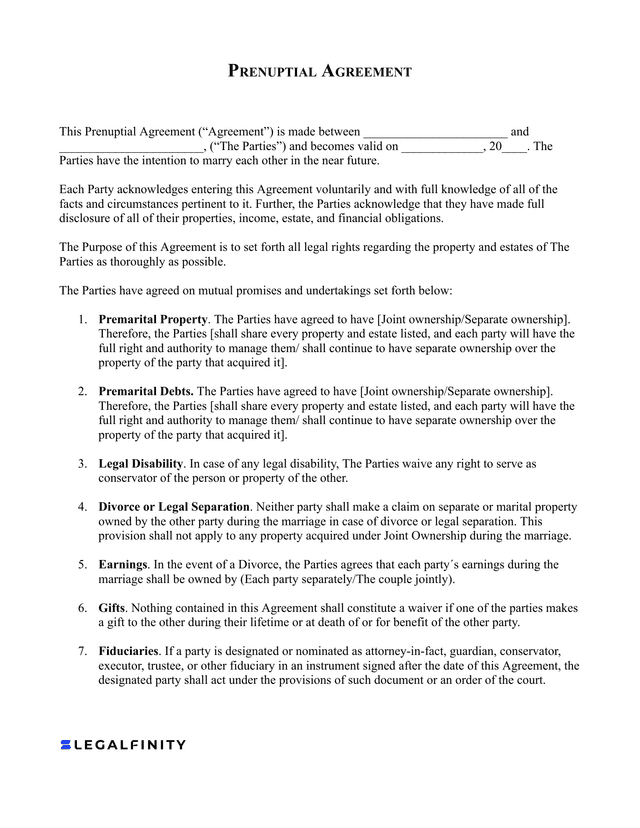
Sample Prenuptial Agreement
Before you draft your own Prenup, it’s important to understand what it should contain and the general structure of the document. You can use the example below as a guide:
How a Prenup Works
A Prenup is legally binding when it follows the rules set out in the Premarital and Marital Agreements Act and state laws. Generally, this means that both parties must:
- Fully disclose their finances
- Have the chance to consult a lawyer
- Agree to include fair and reasonable terms in the agreement
- Have the document properly signed and notarized
Meeting these requirements guarantees that your agreement is transparent and enforceable.
What is Typically Included in a Prenup?
A Prenuptial Agreement can cover a wide range of financial and personal matters. To make sure your intentions are honored, every clause should be clearly written and agreed upon before signing.
This helps prevent misunderstandings and protects both partners if the marriage ends or circumstances change.
| Clause | Purpose |
|---|---|
| Property Division | Explains how property and assets will be split if the marriage ends, including who keeps specific items like a home or vehicle. |
| Debts and Assets | Lists what each person owns or owes before marriage to ensure those assets or debts remain theirs in a divorce. |
| Financial Responsibilities | Defines how everyday expenses and shared financial duties will be handled during the marriage. |
| Spousal Support (Alimony) | Sets out whether alimony will be paid, how much, and under what conditions. |
Writing Your Own Prenuptial Agreement
To create a valid and effective prenup, you’ll need to include key details that make the agreement fair and legally enforceable. Below are the main steps:
- Include each partner’s details: List both parties’ full names, contact information, financial details, legal representation, and any prior marriages or children.
- Decide how property is divided: Specify ownership of assets before and during the marriage, and clarify how property will be split if you divorce.
- Address business ownership: State each business’s value and decide whether future growth or new ventures during the marriage will be shared or remain separate.
- Assign debts and taxes: Outline who is responsible for pre-marriage and marital debts, and decide if taxes will be filed jointly or separately.
- Define home ownership and expenses: Clarify who owns the marital home and how household costs will be divided.
- Add final provisions: Include clauses for waivers, disability or death provisions, conflict resolution, and applicable state laws.
- Meet signing requirements: Make sure both parties sign the document according to state law. You’ll often need to do this before a notary and one or more witnesses.
You can create an agreement tailored to your situation in just a few minutes with our customizable Prenuptial Agreement.
After creating your agreement, it’s a good idea to have a legal professional review it.
Prenuptial Agreement Signing Laws by State
The laws surrounding the signing of a Prenup vary from state to state. Make sure to find out what the requirements are in your state with the list of the table below:
| State | Requirement | Law |
|---|---|---|
| Alabama | Both spouses’ signatures only | § 386 So. 2d 749 (Ala. Civ. App. 1980) |
| Alaska | Both spouses’ signatures only | § 733 P.2d 1044, 1048-51 (Alaska 1987) |
| Arizona | Both spouses’ signatures only | § 25-202 |
| Arkansas | Prenuptial Agreement Acknowledgement needs to be included | § 9-11-402 |
| California | Both spouses’ signatures only | § CA Fam Code 1611 |
| Colorado | Both spouses’ signatures only | § 14-2-306 |
| Connecticut | Both spouses’ signatures only | § Sec. 46b-36c |
| Delaware | Both spouses’ signatures only | § 322 Formalities |
| District of Columbia (D.C.) | Both spouses’ signatures only | § 46–502 |
| Florida | Both spouses’ signatures only | § 61.079 (3) |
| Georgia | A notary and 1 witness | § 19-3-62 |
| Hawaii | Both spouses’ signatures only | § 572D-2 Formalities |
| Idaho | Both spouses’ signatures only | § 32-922 – Formalities |
| Illinois | Both spouses’ signatures only | § 750 ILCS 10/3 |
| Indiana | Both spouses’ signatures only | § IC 31-11-3-4 |
| Iowa | Both spouses’ signatures only | § 596.4 Formalities |
| Kansas | Both spouses’ signatures only | § 23-2403 |
| Kentucky | Both spouses’ signatures only | KRS 371.010 |
| Louisiana | Each signature needs to be notarized | § CC 2331 |
| Maine | Both spouses’ signatures only | § 603 |
| Maryland | Both spouses’ signatures only | § Stewart v. Stewart. No. 0249, 2011) |
| Massachusetts | It needs to be registered in the Registry of Deeds where the husband resides | Title II, Chapter 209 |
| Michigan | Both spouses’ signatures only | § 566.132, Sec. 2(1)(c) |
| Minnesota | Each signature must be notarized | § 519.11 |
| Mississippi | Each signature must be notarized | Murr v. Murr, 418 So. 2d 1067 (Miss. 1982) |
| Missouri | Both spouses’ signatures only | § 451.220 |
| Montana | Both spouses’ signatures only | § 40-2-606 |
| Nebraska | Both spouses’ signatures only | § 42-1003 |
| Nevada | Both spouses’ signatures only | § 123A.040 |
| New Hampshire | Each signature must be notarized | Matter of Barnes, 708 A.2d 104 (N.H. 1998) |
| New Jersey | Both spouses’ signatures only | § 37:2-33 |
| New Mexico | Both spouses’ signatures only | § 40-3-3 |
| New York | Each signature must be notarized | § 236(B) |
| North Carolina | Both spouses’ signatures only | § 52B-3 |
| North Dakota | Both spouses’ signatures only | § 14-03.1-03 |
| Ohio | Both spouses’ signatures only | § 1335.05 |
| Oklahoma | Each signature must be notarized | § 43-205 |
| Oregon | Both spouses’ signatures only | § 108.700 |
| Pennsylvania | Both spouses’ signatures only | Simeone v. Simeone, 581 A.2d 162 (Pa. 1990) |
| Rhode Island | Each signature must be notarized | § 15-17-2 |
| South Carolina | Both spouses’ signatures only | § 20-1-960 |
| South Dakota | Both spouses’ signatures only | § 25-2-16 |
| Tennessee | Both spouses’ signatures only | Boote v. Shivers, 198 S.W.3d 732 (Tenn. Ct. App. 2005) |
| Texas | Both spouses’ signatures only | § 4.002 |
| Utah | Both spouses’ signatures only | § 30-8-3 |
| Vermont | Both spouses’ signatures only | § 3154 |
| Virginia | Both spouses’ signatures only | § 20-149 |
| Washington | Each signature must be notarized | Matson v. Matson, 333 P.2d 938 (Wash. 1959) |
| West Virginia | Each signature must be notarized | § 48-2-1 |
| Wisconsin | Both spouses’ signatures only | § 766.58 |
| Wyoming | Both spouses’ signatures only | § 2-5-102 |
Try Legalfinity Now
Instant and complete access to our entire library of legal forms
Edit, download and print in PDF and Word format from any device
Save time and money on legal document creation